




Maldives Opposition Reunites: Nasheed Rejoins MDP Amidst Tensions with Solih
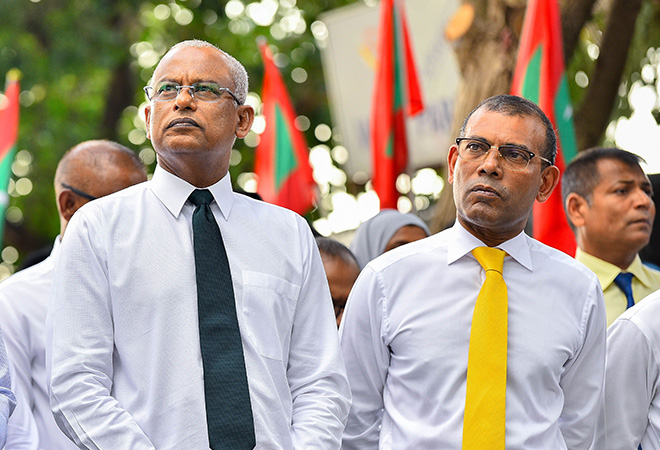
In a surprising turn of events, former President Mohamed Nasheed, the once fierce critic of the Maldivian Democratic Party (MDP), has once again rejoined the party he helped establish. His decision comes after the dissolution of the Democratic Party, a significant opposition force in the country’s political landscape. Nasheed’s re-entry into the MDP, however, is far from a peaceful reconciliation; it signals ongoing political tensions, particularly with his former ally, President Mohamed Solih.
Nasheed’s Return to the MDP: A Full Circle
Nasheed’s political journey has been anything but linear. As a founding member of the MDP and a key figure in the party’s rise to power, he served as the President of the Maldives from 2008 to 2012. His tenure, however, was marred by controversy, and after his ousting, Nasheed became an outspoken critic of both the political establishment and his former party comrades.
Over the years, Nasheed’s relationship with the MDP oscillated between cooperation and acrimony. His decision to leave the party in 2016, amid mounting tensions with President Solih, seemed like the final break. Nasheed then went on to form his own faction, the Democratic Party, hoping to carve out a new political identity.
But with the recent dissolution of the Democratic Party, and amid growing pressures within the opposition bloc, Nasheed has decided to rejoin the MDP, putting an end to his brief estrangement from the organization. His return is seen as an attempt to consolidate opposition forces ahead of upcoming elections, but his personal animosities with Solih suggest the move is far from a purely strategic one.
The Rift with Solih: Nasheed’s Continuing Rivalry
Despite Nasheed’s decision to return to the MDP, the former President has made no secret of his ongoing resentment toward Mohamed Solih, the current head of the party. Their once-strong alliance has been fractured by ideological differences and power struggles that have only intensified in recent years. Nasheed’s re-entry into the MDP is being interpreted by many as an effort to wrest control of the party from Solih, whom he accuses of mismanaging the government and betraying the principles of the MDP.
Sources close to Nasheed claim that he views Solih as a weak leader, whose tenure has failed to live up to the vision of reform and progress that Nasheed had originally championed. Though Nasheed’s return to the MDP was presented as a gesture of unity, it has become clear that the former President is actively working behind the scenes to weaken Solih’s grip on the party.
Political Turmoil Ahead
Nasheed’s re-entry into the MDP could destabilize the political landscape of the Maldives, with both the ruling and opposition factions bracing for a potential showdown between the two political heavyweights. Observers suggest that Nasheed’s motivations are not solely driven by a desire for party unity, but by a deeper ambition to undermine Solih’s leadership, potentially positioning himself as a stronger candidate for the presidency in future elections.
With both men now vying for control of the MDP, it remains to be seen how this rivalry will affect the party’s ability to mount an effective challenge against the ruling Progressive Party of the Maldives (PPM), led by President Abdulla Yameen. The next few months will likely see an escalation in political maneuvering, as Nasheed and Solih continue their power struggle, each attempting to outflank the other in both the party and the broader political arena.
For now, the political situation in the Maldives remains fluid, with many wondering how long Nasheed and Solih can coexist within the same party. As the battle for control of the MDP intensifies, the Maldivian political landscape is set for a new chapter of uncertainty and intrigue.